
Key terms: coffee grinder settings explained | coarse to fine grind coffee | grind size brew style guide | coffee maker grind settings chart | best grind for drip espresso French press
Coffee grind settings are one of those things that seem complicated until someone explains the underlying logic — after which they seem obvious. The core idea: grind size controls how fast water extracts flavor from coffee. Everything else follows from that.
Extra coarse grind (the highest number on most machine dials) is used for cold brew coffee. Cold brew uses cold water and 12–24 hours of contact time, so the grind needs to be very coarse to avoid over-extraction during that long steep. Particles should look like coarse sea salt. At room-temperature brewing with hot water, this grind would be catastrophically weak — nothing would extract properly in a 4-minute window.
Coarse grind serves French press and percolator coffee. French press steeps for 4 minutes with no filter, so coarse particles slow extraction enough to produce a balanced cup. Fine grounds in a French press would produce a bitter, over-extracted result plus excessive sediment. Percolators cycle the same water repeatedly over the grounds, requiring coarse grind to prevent progressive over-extraction.
Medium-coarse grind hits the sweet spot for Chemex and cafe au lait preparations. The Chemex‘s thick paper filter slows water flow, extending contact time slightly beyond standard drip. Medium-coarse prevents over-extraction through that longer flow time.
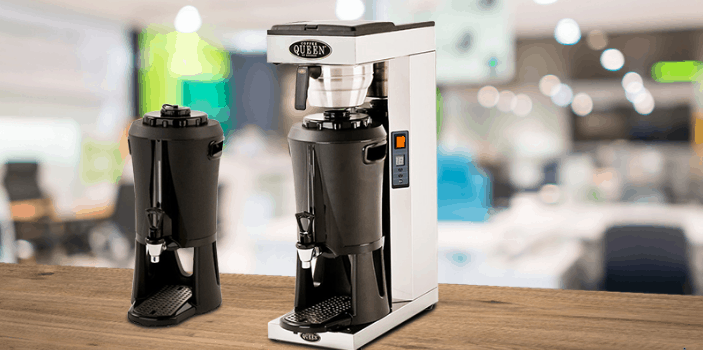
Medium grind is the default zone for standard drip coffee makers — the automatic machines most households use. Water passes through the grounds over 4–6 minutes under gravity. Medium grind provides enough surface area for complete extraction without the bitter over-extraction that a finer grind would cause. If your drip coffee maker with grinder suggests a starting point, it’s probably “medium” for good reason.
Medium-fine grind works for pour-over coffee (V60, Kalita Wave) and Aeropress at standard 2–3 minute brew times. Pour-over requires precise water control and slightly more even extraction than automatic drip, so slightly finer grind compensates for faster manual water flow.
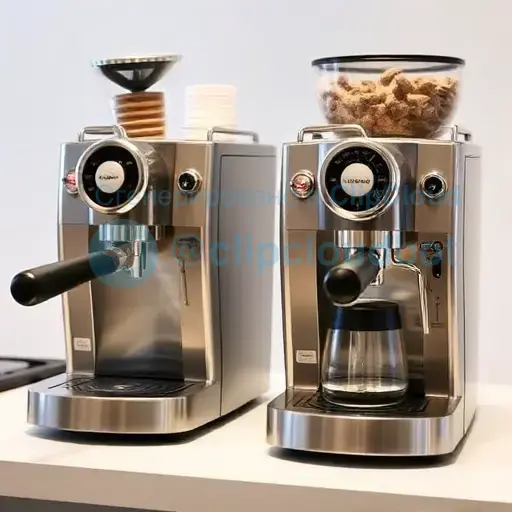
Fine grind is espresso territory. Water under 9 bar of pressure passes through a compact coffee puck in 25–30 seconds. The grind must be fine enough to create resistance — too coarse and the water rushes through in 10 seconds, producing under-extracted, sour espresso. Fine espresso grounds should look and feel like powdered sugar. This is the most sensitive adjustment point: changing one setting can shift extraction from under to over in a single increment.
Extra fine grind is used for Turkish coffee, where coffee is boiled directly in water with no filtration. Almost powder-fine. No drip machine produces this level of fineness — it requires a Turkish grinder or a coffee machine specifically designed for the style.
Grind consistency across settings matters as much as the setting itself. A machine set to “medium” that produces a mix of fine and coarse particles is worse than a machine set to “slightly coarser medium” that produces uniform medium particles. This is why burr grinders outperform blade grinders even at equivalent settings — the uniformity, not just the average size, determines extraction quality.
Brew strength vs. grind size: many coffee makers conflate these with a single “strength” setting. They’re actually different variables. Brew strength (often controlled by dose — how much coffee per unit water) affects overall intensity. Grind size affects extraction character — whether the flavor is bright and sweet or deep and bitter. On machines with separate brew strength and grind size controls, adjust them independently. Strength up for more coffee taste. Grind finer for more complexity and body. Coarser grind for lighter, cleaner cup.
The practical starting point for any coffee maker with a built-in grinder: use the manufacturer’s recommended starting grind for your brew method, brew a cup, taste carefully, and adjust one notch at a time. Document what works. Coffee dialing is a process, not a one-time setup.