
Key terms: how bean-to-cup machines work | coffee machine engineering | integrated grinder mechanics | automatic coffee maker mechanism | bean-to-cup machine technology
There’s a surprisingly elegant sequence of mechanical events happening every time you press the button on a bean-to-cup coffee machine. Understanding that sequence helps you use the machine better, diagnose problems faster, and appreciate why certain design choices cost more than others.
It starts at the bean hopper. This is the sealed container (usually 200–400g capacity) that holds your whole beans. Better machines use UV-resistant material and an airtight seal to slow oxidation. The hopper feeds beans into the dosing chamber — a small compartment that measures roughly how many beans should drop into the grinder for a single or double serving. The dosing mechanism varies: some use auger screws, some use gravity with a shutter valve, some use more precise dosing wheels. This is where weight-based dosing (common in high-end machines) vs. volume-based dosing (more common in mid-range) diverges in accuracy.
The grinder sits below the dosing mechanism. In a conical burr grinder, the inner burr is driven by a motor — typically 100–250 watts in home machines, more in commercial units. The outer burr is stationary. Beans feed from the top, travel down between the burrs, and exit as ground coffee from the bottom. The grind size is controlled by adjusting the gap between burrs, either via a stepped collar (fixed increments) or a stepless mechanism (infinite adjustment). Stepless is more flexible; stepped is more reproducible.
Ground coffee exits the burr assembly through a grind chute — a short channel that delivers grounds to either a portafilter (in semi-automatic espresso machines) or directly to the brew group (in superautomatic machines). This chute is a known weak point: it can clog with fine grounds, especially with oily dark-roast beans. Many machines include a cleaning cycle specifically for the chute.
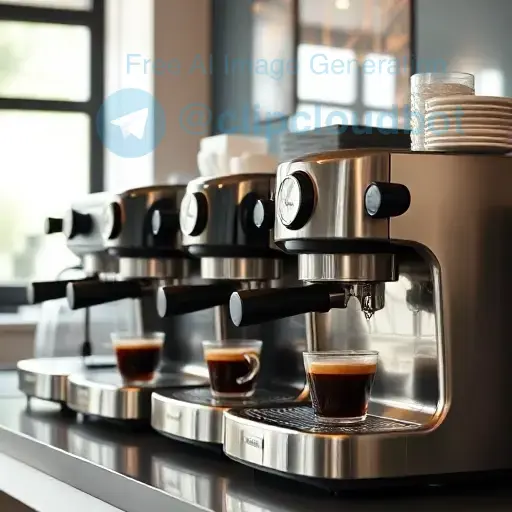
The brew group is the heart of the machine — where hot water meets ground coffee under pressure. In espresso-style bean-to-cup machines, a pump (usually a vibratory pump or a rotary pump in higher-end models) generates 9 bar of pressure. Water from the boiler or thermoblock reaches the brewing temperature — typically 90–96°C — and is forced through the coffee puck. Thermoblock systems heat water on demand and reach temperature faster. Single boiler systems heat a fixed volume of water and need time to recover between shots. Dual boiler systems run brew and steam simultaneously without temperature compromise.
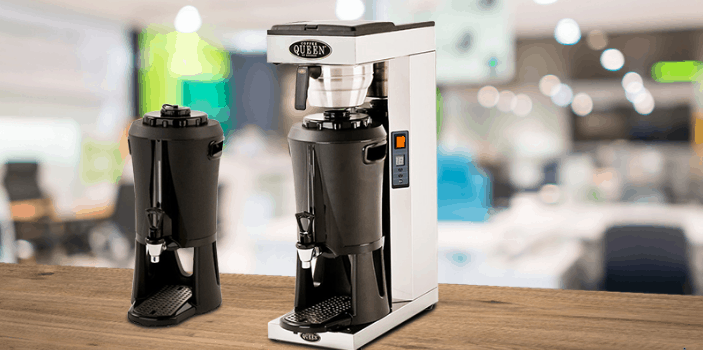
In drip-style bean-to-cup machines, the mechanism is different: a heating element heats water to just below boiling, a showerhead distributes it evenly over the coffee bed in the filter basket, and gravity does the extraction work over 4–6 minutes. No pressure involved. The brewing temperature is critical here — SCA standards specify 200°F (93°C) as optimal; machines that brew at 180°F or below produce noticeably weaker, under-extracted coffee.
Pre-infusion is a feature on higher-end machines that briefly wets the coffee puck at low pressure before full extraction begins. This allows CO2 from freshly roasted beans to escape (bloom) before pressure is applied, improving extraction uniformity. You’ll see this advertised as “pre-wetting,” “pre-infusion,” or “bloom function.”
After brewing, superautomatic machines use a mechanism to eject the spent coffee puck — compressed grounds — into an internal waste drawer. The machine typically signals when the drawer needs emptying (after 10–15 cycles). The quality of puck ejection varies; some machines produce dry, clean pucks, others leave a messy residue in the group.
Electronic controls manage the whole sequence. Modern machines use sensors for water level monitoring, temperature regulation, grind dose tracking, and scale detection (hard water calcification). Programmable coffee machines allow you to store brew parameters — volume, temperature, grind setting, brew strength — for different profiles. Firmware updates via USB or Bluetooth are now appearing on premium models.
Understanding this sequence — hopper → dosing → grinding → brewing → ejection — helps you identify where problems originate. Coffee too weak? Start with the dosing or grind setting. Machine clogging? Check the grind chute. Temperature inconsistent? Look at the thermoblock or boiler size.